4 min read
Carroll Gardens' Italian Coffee Heritage: D'Amico on Court Street Since 1948
D'Amico Coffee Roasters has been roasting on Court Street since 1948. How an Italian-American neighborhood built a coffee scene that predates third-wave Brooklyn.

Most Brooklyn coffee discourse skips Carroll Gardens. The neighborhood is not third-wave-coded. There is no wall of natural process Ethiopian on a chalkboard, no Acaia Pearl on every bar, no barista in a Sey hat explaining why the cup tastes like jasmine. And yet, the corridor between Court Street and Smith Street is one of the most consistent coffee neighborhoods in the borough, and the analytics on this site keep telling us that people who search for it actually click through and stay. The reason is structural. D'Amico Coffee Roasters has been roasting on Court Street since 1948. That is a Brooklyn coffee culture that predates the third wave by decades, and the rest of the neighborhood was built around it.
D'Amico sits at 309 Court Street, the oldest continuously operating coffee shop in Brooklyn. Walk in and you notice the smell of beans being roasted on site, not the smell of a cafe that buys beans from someone else and grinds them on a Mahlkönig. The blends lean dark and Italian, built for cups served small, hot, and quick. You can buy beans by the pound out of bins on the wall, the way Italian groceries in the neighborhood still sell olives and dried pasta. It is a business well into its eighth decade doing the thing it has always done, with the same equipment and the same kind of customer.
That root system shapes everything that came after. The dominant mode of coffee in Carroll Gardens is not the pour-over flight or the 100-gram dose ceremony. It is espresso and a pastry, taken at a small table or standing at a counter, ten minutes at most. The neighborhood is brownstone Brooklyn, which means people walk and people linger, but they linger in groups and over food, not over a single cup with a laptop. If you cross north into Cobble Hill, the corridor extends but the tempo stays the same. The cafes here compete on warmth and consistency, not on novelty. A new shop that tries to disrupt the rhythm tends to get quietly absorbed or quietly replaced.
The most recent addition to the corridor is Liz's Book Bar, a Black-owned bookstore-cafe-wine-bar that opened in 2024 at 315 Smith Street. On paper it sounds like three businesses jammed into one room, and in a different neighborhood it might read as too much. In Carroll Gardens it reads as exactly right, because the neighborhood rewards places you can sit in for a long time on a Saturday afternoon. The coffee program is serious, the bookshelf is curated rather than decorative, and by evening the same room turns into a wine bar without a hard transition. The whole concept is built on the assumption that people want to stay, which is the same assumption D'Amico has been operating on since 1948.
A few blocks down at 345 Smith Street, Emma's Torch runs a culinary training program for refugees alongside its coffee and food service. The mission gives the room a different weight than a standard cafe. You are getting coffee that is well-made, but you are also supporting a training kitchen, and the staff turn over the way they should in a program built around teaching people new trades. Carroll Gardens has a high density of these social-mission operations, which is part of why the corridor reads as community-first rather than hype-first. The shops are not competing for the same Instagram audience. They are filling different roles in a neighborhood that knows what it wants out of a cafe.
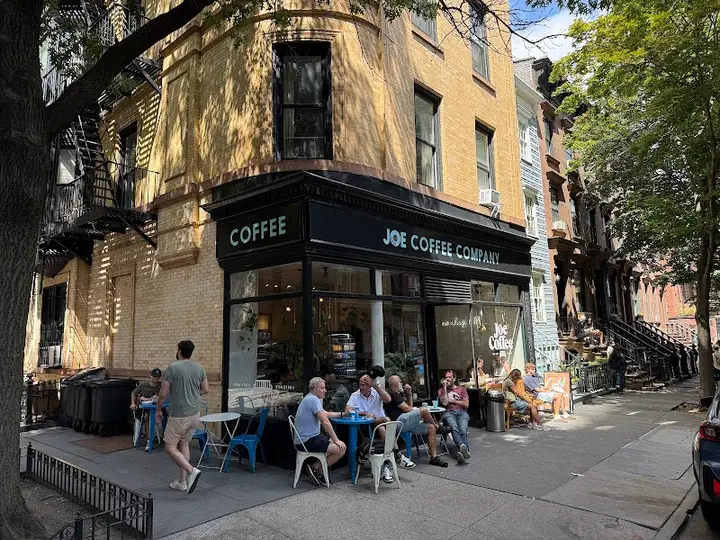
The post-2020 wave kept this pattern. Planted Cafe at 100 Carroll Street is part cafe and part plant shop, a concept that sounds gimmicky and then turns out to work because Carroll Gardens has the patience for a slow visit. Nili brings eastern-Mediterranean food and Joe Coffee to Smith Street, and Henry's Local runs the steady morning trade, Brooklyn Habit and Black Gold Records each layer a second identity (wine bar, record shop) onto the cafe baseline. None of these places are trying to compete with third-wave specialty bars in Williamsburg or Bushwick. They are doing something the third-wave bars are not set up to do, which is hold a neighborhood through a whole day.
This is why the search traffic for "coffee shop carroll gardens" converts the way it does. The people typing that query are not looking for the next Sey or the next Devoción. They are looking for a place to sit on a Sunday morning, or duck into between errands on Court Street. A neighborhood with one anchor that has been there since 1948 sets a tempo, and the businesses that survive are the ones that respect it.
If you are putting together a day, start at D'Amico for a quick espresso, walk Court Street south, cut over to Smith for Liz's or Emma's Torch, and then continue north toward Cobble Hill. For a slower angle on the same corridor, the first-date coffee shops in Brooklyn guide leans on Liz's Book Bar for exactly this reason. The corridor was built for sit-and-stay, and the data keeps telling us that is what people actually want when they search for it.
Frequently asked
- What is the oldest coffee shop in Brooklyn?
- D'Amico Coffee Roasters at 309 Court Street is the oldest continuously operating coffee shop in Brooklyn, roasting on site since 1948. Its blends lean dark and Italian, built for cups served small, hot, and quick, and you can still buy beans by the pound out of bins on the wall.
- Where should I get coffee in Carroll Gardens?
- Start at D'Amico on Court Street for a quick espresso, then cut over to Smith Street for Liz's Book Bar (a bookstore-cafe-wine-bar at 315 Smith Street) or Emma's Torch (a refugee culinary training program at 345 Smith Street). Other corridor options include Planted Cafe at 100 Carroll Street, Nili, Henry's Local, Brooklyn Habit, and Black Gold Records.
- Is Carroll Gardens a good neighborhood for specialty coffee?
- Carroll Gardens is one of the most consistent coffee neighborhoods in Brooklyn, though it is not third-wave-coded the way Williamsburg or Bushwick are. The dominant mode here is espresso and a pastry taken in ten minutes, anchored by D'Amico's Italian roasting tradition since 1948, with cafes that compete on warmth and consistency rather than novelty.
Worth a visit
Coffee shops that fit this story.